This autumn has shown how differently Finnish and swedish university students view political activism.
Text: Aline Forsström
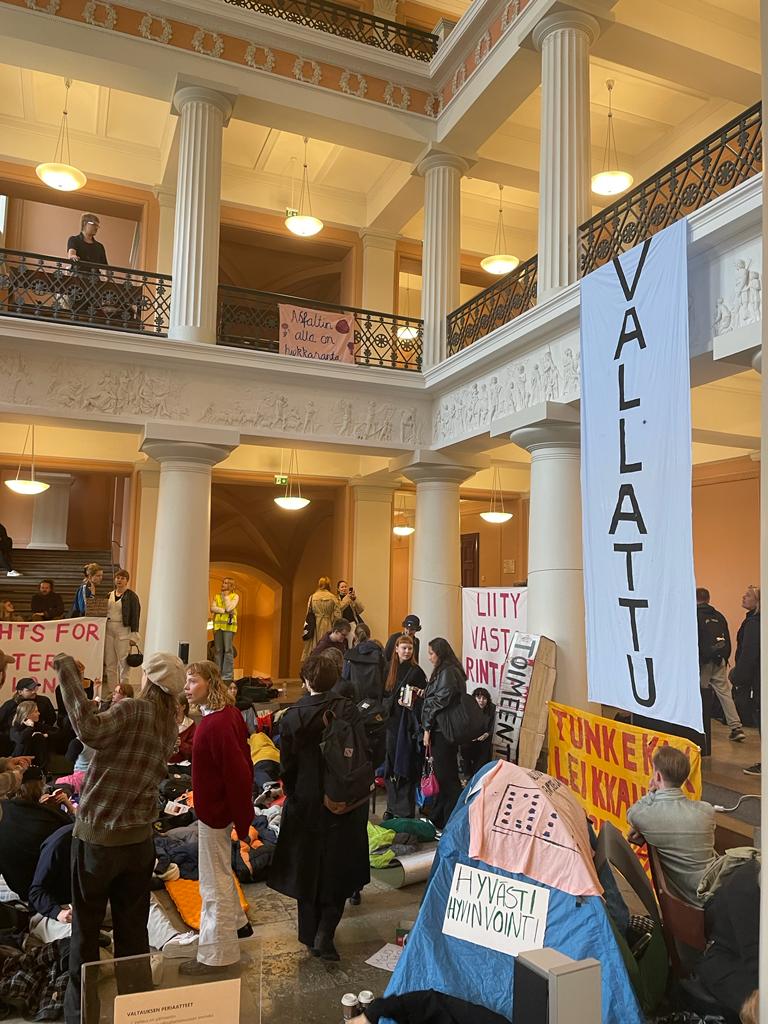
My friend Alice told me recently that Finnish students took control over a university building a few weeks ago, in protest of the universities’ ties with Israel. My first thought was how daring it was. The thought that followed was how Swedish students have yet to take any drastic action to protest the war. I think that this highlights a bigger issue in the Swedish student life: Swedish students are no longer politically active.
I know that when I express this hypothesis, I merely have my own perspective to base it on. However, I think what I see in Lund today is that political interest has decreased over the years. Students, who historically have been a significant political group in society, no longer show any enthusiasm for political issues. Of course students are aware of the political climate and have opinions on current issues, but they no longer have the passion to pursue action to affect the outcomes. I think there are a few causes that could explain this result.
One reason is that students don’t have the time to be politically active. The competition between peers, the pressure to have a rich social life and also a prosperous CV makes it hard to have any interest in anything other than getting by.
Another reason that I believe that students have lost political interest is because of social media. With the surge of social media, everyone can be a social justice warrior. A lot of political issues, like the Israel-Hamas war, have been condensed into a slide of different graphic pictures and information about the war. Most people stop there and think that they are done with political action. However, social media has little influence at times, if it is not combined with protests and real pressure towards politicians. Often social media also oversimplifies the political issues and misses a lot of information. With social media, you don’t have to know about the issue, you just have to post about it to show your support.
The final reason why I suspect this, which is specific to Swedish students, is that we have never lived in a nation that has dealt with war. Modern Sweden has never (on paper) been an active part in a war or conflict; we have always been a ‘neutral’ country and this has left us with the permanent feeling of safety, which means that Swedish people have complete faith in that everything will work out, because we haven’t known anything else. After the Ukraine war started, that feeling was shaken for a month, and then that feeling became stable again, because our government applied for NATO membership to protect us from a possible attack. It’s not wrong to trust the government, but it is beneficial to care about what they do.
As a political science major, this is a negative development. In Sweden, we have a government that is testing the lines of morality and ethics. Today, on the 21st of November, the ruling parties have presented a proposition that immigrants in Sweden have to verify that they conform to ‘Swedish life standards’, as well as that they can make a person stateless. The propositions in themselves are dystopic and show that Sweden is going in the wrong direction; these suggestions are clearly aimed at particular groups in society that are deemed undesirable, and there is no way that the government can legitimize its action without breaking any moral code. The proposed actions also dehumanize the groups it is aimed at, in a way to turn the majority against them.
In this dire situation, Sweden is in need of its students and their unique position to prevent such misconduct from happening in their own country. If not, history will back and condemn them from not taking action.
The author is a political science student at University of Lund and editor of the student publication Panorama.

