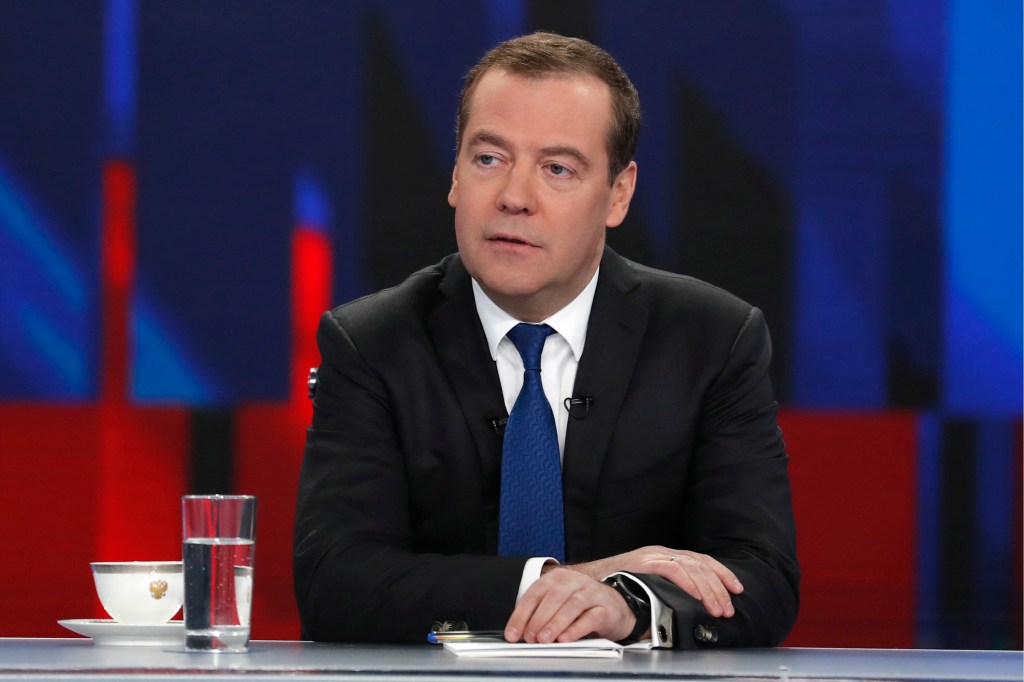
Text: Héloïse Vié • Image: Government.ru / Wikimedia Commons / CC BY 4.0
Recent events have highlighted certain attacks by Moscow against Helsinki through offensive actions or rhetoric. The threat of an attack on Finland after Ukraine looms large, particularly following Dmitry Medvedev’s statements on September 8, 2025, in an article for TASS, a Russian news agency. The purpose of this article is therefore to briefly revisit the origins of the rift in Finnish–Russian relations, to understand recent events, and to take a broader look at the threat to NATO. How can the attitude of Moscow towards Helsinki be interpreted through the broader lens of an attack on NATO?
THE STARTING POINT: 2023, FINLAND JOINS NATO
The policy of breaking with Finland’s historic neutrality began slowly when it joined the European Union in 1995 but came to a definitive end upon joining NATO immediately after Russia’s attack on Ukraine in February 2022. This event radically changed the Kremlin’s view of Helsinki. Former Russian President Dmitry Medvedev stated that Finland had joined NATO under the guise of defence but in reality, to prepare for war against Russia.
This immediate reaction from Moscow is also interpreted through the prism of fear by some journalists. Sergei Lavrov announced in 2022 that NATO membership would have “serious political and military consequences”. The neutrality of Finland and Sweden was almost indispensable for Russia because “the neutrality policy of these two countries is one of the pillars of the common European architecture and the maintenance of stability in Europe”, The Minister of Foreign Affairs said. The two countries represented a buffer zone with NATO, which Russia has now been deprived of. It was therefore the loss of influence and control over its Finnish neighbor that prompted Russia to resort to open threats.
Although threats were not non-existent before, the former president’s recent statement openly threatens Finland with being the next country to be attacked after Ukraine. The argument used by Moscow is peculiar. Finland is accused of having a Nazi policy similar to that of Germany in the 1940s. Finland cooperated with Nazi Germany during World War II, and this argument is being used to portray the country as an enemy. Russia’s use of propaganda and alternative rewriting of history is not insignificant. The aim is to portray Finland as a common enemy, due to the worldwide rejection of Nazism, while omitting any responsibility on Russia’s part. By presenting Finland as a Nazi nation threatening Russia, a parallel with the situation in Ukraine is obvious. On February 21, 2023, Vladimir Putin stated in a speech that a neo-Nazi regime had taken power in Ukraine and that this justified the special operation. The propaganda omitted the fact that only 2% of Ukrainians had voted for the far right, that Volodymyr Zelensky was Jewish, and that members of his family had been victims of the Holocaust. Another argument used by Moscow was to accuse Finland of persecuting ethnic Russians and wanting to erase their identity. This argument of protecting Russian minorities is not new and was also used to justify the special operation in Ukraine under the accusation of “Russophobia”.1
It is precisely this parallel between the invasion of Ukraine and Finland on charges of Nazism that raises fears about Finland being next on the list. “While the Finnish public remains largely indifferent for now, it is clear that the situation could change rapidly, especially in the aftermath of the war in Ukraine or if it turns into a prolonged frozen conflict,” said Joni Askola, a Finnish geopolitical analyst. He also explained that “while Finland does not currently perceive an immediate threat, given Russia’s preoccupation with its war in Ukraine, the strategic landscape could change once that conflict is over.”2 The threat is therefore not imminent, but it is nonetheless real.
HYBRID WARFARE
Russia is using hybrid warfare tactics against Finland. This refers to “a war fought by both conventional military methods and techniques such as cyberwarfare, dissemination of disinformation, and the use of paramilitary combatants”3. The aim of this practice is to destabilize, create uncertainty, and weaken internal cohesion without crossing the threshold into open warfare.
The instrumentalized migration
The first strategy used by Moscow in its hybrid warfare is the instrumentalization of migrants to put pressure on the country and, moreover, provoke a humanitarian and political crisis. The aim is to use the immigration debate to divide the country. Border posts have therefore been gradually closed to prevent Russian nationals from entering the country and fences have been built in certain places along the border. The Finnish authorities then declared: “It was clear that foreign authorities or other actors were facilitating instrumentalised migration. This phenomenon and the risk of its escalation posed a serious threat to national security and public order in Finland.”4 Russian incursions have nevertheless been observed, particularly near the border between North Karelia and Russia. Some experts believe that Russian soldiers have been trained to enter through forests that are difficult to access.5
The rising military
Russia has also embarked on a strategy of increasing military infrastructure and deployments on the Finnish border. This strategy was explained by Dmitry Medvedev, who stated that he wanted to increase military infrastructure on the border if the Nordic countries joined NATO. He also suggested that Russia should prepare for military exercises by training to consider Finland as an enemy.6 Since the reconstruction of the Kaliningrad military base in 2010, Finland has remained vigilant and has set up a system for supplying troops and military equipment via Sweden and the port of Narvik in Norway. For example, satellites have shown the construction of military bases in Petrozavodsk, 175 km from the border.7 Similarly, the construction of an artillery garrison in the Murmansk region and a military camp storing armored vehicles had been detected 150 km from the border.8 The military threat at the border had occurred before the invasion of Ukraine in 2022, so the threats were taken very seriously by Helsinki.
IS RUSSIA THREATENING NATO IN GENERAL OR MORE SPECIFICALLY FINLAND?
Although Finland is in a very unique situation due to its history, Russia has recently been aggressive toward multiple NATO member countries. Five examples stand out in particular: Poland, Romania, Estonia, Denmark and Norway. These destabilization operations are part of an overall effort to test NATO’s response capabilities and undermine its credibility.
The Polish case
At least three Russian drones were shot down by Poland on the 9th of September, and President Donald Tusk confirmed 19 drone incursions into Polish airspace, flying too close to several airports. This is the first time Russian drones have flown over a NATO member country since the invasion of Ukraine. Incursions had already taken place in November 2022, but the recent incident is more alarming because the incursion involved both armed and unarmed drones. Mirosław Kaznowski, mayor of a town on the outskirts of Warsaw, told the BBC: “We need to be prepared. This has all now gone higher on the agenda.”9 Poland then requested consultations between the 32 NATO members, under the terms of Article 4 of the NATO Charter. And indeed, NATO countries responded by increasing airspace defence capabilities and sending aircraft.10
The Romanian case
After the Polish incident, Romania became the next target of Russia’s provocations. While Romania had already received several drone fragments on its territory since the invasion of Ukraine, this time two F-16 combat drones were detected in Romanian airspace. The drones remained there for nearly an hour.11 The Romanian defence minister responded by strongly condemning “the irresponsible actions of the Russian Federation” and stating that “they represent a new challenge to regional security and stability in the Black Sea area.”12 Kaja Kallas, the EU’s foreign policy chief herself described the incident as a “reckless escalation” on the part of Moscow. Ukrainian President Volodymyr Zelensky warned of the deliberate expansion of drone operations in the west and called for tougher sanctions and closer cooperation in terms of defence.
The Estonian case
Three Russian MiG-31 fighter jets flew over Estonian airspace for twelve minutes on Friday, September 19. Estonian Foreign Minister Margus Tsahkna said that this “is part of a broader pattern of behavior by Russia, aimed at testing the resolve of Europe and NATO” and prompted an emergency meeting with NATO members. This was the first time in 34 years of membership that the country had requested an emergency meeting13 and the second time this month that article 4 has been invoked14. The incident is the most serious violation of airspace to date, but the Estonian foreign minister also said that it was consistent with Russia’s behavior and that responding to provocations could have significant consequences.
The Kremlin has criticized NATO countries for worsening relations by falsely accusing Russia of violating their airspace. The Kremlin spokesman said on September 22 that “We consider these statements to be meaningless, unfounded, and part of a completely unrestrained policy of stirring up tensions and provoking a climate of confrontation.”15 The UN Security Council plans to meet on September 22, while NATO member countries will meet on September 23 in Brussels. The successive threats have been taken seriously by international organizations.
The Norwegian and Danish cases
On September 22, drones were detected near Oslo and Copenhagen airports, causing air traffic to be suspended at both sites until September 23. The communications director for the Danish airport commented: “There have been pranks involving drones in the past, which we were able to quickly deal with. But this time, it was different. These were particularly large drones of a special type.”16 This incident is one of a series of provocations in recent weeks that are undoubtedly increasing tension in Europe. Whenever a NATO country condemns Russia’s actions, Moscow responds offensively by denying and shifting the blame. For example, the Norwegian government described the actions as unacceptable, and the Russian embassy in Oslo responded by stating that the allegations “were not confirmed by objective Russian surveillance data.” The embassy also accused Alliance countries of being responsible for the rise in tensions in the far north, in a letter to AFP.17
Ultimately, Russia has reawakened its latent aggression towards Finland following the latter’s accession to NATO. Using rhetoric similar to that employed in its aggression towards Ukraine, Russia is threatening Finland with potential military action. However, the war in Ukraine was motivated, among many other factors, by the fear that the country would join NATO.18 In the present case, Finland is already a member of the organization and can now rely on Article 5, which allows member states to respond in order to defend a state if it is attacked. If Moscow decided to attack Finland after Ukraine, Finland would not be alone. This is especially true given that Helsinki is pursuing a policy of increasing its military capabilities. Alexander Stubb also declared at the 2024 NATO summit that Finland had the largest artillery in Europe. “We are not afraid of anything, we are ready for anything. […] The only message the Kremlin understands is that of power,” he added.19 In general, Moscow seeks to use intimidation and fear as a strategy to destabilize the West, through a series of provocative actions in member countries. Even though NATO members did not respond to the provocation, the incidents still had a significant impact on the current climate. Furthermore, researcher Etienne Marcuz believes that “this is not the peak of the crisis” and that “we can expect further incursions further west into Europe,” as the countries targeted so far have been in the north and east.20
However, one question remains: is NATO’s response of supplying military equipment really sufficient? The dispatch of three Rafale fighter jets by France and three helicopters and anti-aircraft batteries by the Czech Republic and the Netherlands to Poland are not sufficient to respond to drone attacks. Is this aid really adequate in the long term?21 Increasing the number of Allied aircraft cannot solve all the challenges that arise. To defend their borders, the Allies would need a radar and acoustic detection network, as well as laser-guided rockets produced by the Americans. •
- “Russian Offensive Campaign Assessment”, in Institute for the Study of War, 8.9.25 ↩︎
- Brendan Cole, “Putin Ramps Up Military Fortifications on NATO Border”, in Newsweek, 6.9.25 ↩︎
- Oxford Language dictionary ↩︎
- “Situation at Finland’s eastern border”, Finnish Government ↩︎
- Miranda Bryant, “‘For Russians, Nato is next to Satan’: Finnish guards on alert at Russia border”, in The Guardian, 26.8.25 ↩︎
- Cole (n 2) ↩︎
- World, “Satellite images show Russian military buildup near Finnish border”, in Helsinki Times, 10.5.25 ↩︎
- The Brussels Times with Belga, “Russia strengthens military presence near Finland”, in The Brussels Times, 18.6.25 ↩︎
- Adam Easton and Jaroslav Lukiv, “Poland says it shot down Russian drones after airspace violation”, in BBC, 10.9.25 ↩︎
- Nicolas Barotte, “Après les incursions de drones russes en Pologne, l’Otan lance l’opération ‘Sentinelle orientale’”, in Le Figaro, 15.9.25 ↩︎
- Ian Casey and Alex Boyd, “Romania becomes second Nato country to report Russian drone in its airspace”, in BBC, 14.9.25 ↩︎
- Agence France-Presse, “Romania says Russian drone incursions pose ‘new challenge’ to Black Sea security”, in The Guardian, 14.9.25 ↩︎
- Le Figaro with AFP, “Avions russes en Estonie: le Conseil de sécurité de l’ONU se réunit en urgence ce lundi”, in Le Figaro, 21.9.25 ↩︎
- Jaroslav Lukiv and Joe Inwood, “Estonia seeks Nato consultation after Russian jets violate airspace”, in BBC, 20.9.25 ↩︎
- Christophe Sales, “En direct, guerre en Ukraine: la Russie reproche aux pays de l’OTAN d’aggraver les tensions avec leurs accusations ‘infondées’ sur les violations d’espaces aériens”, in Le Monde, 22.9.25 ↩︎
- Antoine Jacob, “Les aéroports de Copenhague et d’Oslo fermés à cause de drone, ‘une attaque grave’”, in Courrier international, 23.9.25 ↩︎
- Victor Mérat and Steve Tenré, “Survol de drones au Danemark et en Norvège: l’ambassade de Russie à Oslo accuse l’Otan d’être responsable d’une montée des tensions dans le Grand Nord”, in Le Figaro, 24.9.25 ↩︎
- Tom Switzer, “Why NATO Expansion Explains Russia’s Actions in Ukraine”, in Australian Institute of International Affairs, 26.7.24 ↩︎
- “Finland has the largest artillery in Europe”, in Naapuriseuran Sanomat, 12.7.24 ↩︎
- Amaury Coutansais-Pervinquière, “Drones au Danemark, ‘On peut s’attendre à d’autres incursions plus à l’ouest en Europe’”, in Le Figaro, 23.9.25 ↩︎
- Chloé Hoorman and Elise Vincent, “L’intrusion russe dans l’espace aérien de la Pologne met en lumière la faiblesse des moyens de l’OTAN pour lutter contre les drones”, in Le Monde, 19.9.25 ↩︎
 Policy